
24xx games as Escape Rooms
Alex rambles about creating "not-quite-escape-room" games with the 24xx SRD


I've been working on a lot of weird microgames over the last year, using the 24xx SRD as the base. If you're not familiar with 24xx, go check out the 2400 bundle (affiliate link). Jason's done a great job of making a NSR style micro game framework, and I've really enjoyed making little game in it.
Because of its lineage, 24xx leans heavily into a few different ideas, but there are two in particular I want to cover today:
- The rules are small and ambiguities are settled at the table.
- Random tables to generate the action when necessary.
These two design elements lend themselves to creating a certain style of micro game — essentially a series of "locations" with randomly generated areas that the players must travel to. I've created a bunch of these so far, but in particular 4321: ASCEND, _ _ _ _ Psyche, and Ferryfolk follow this pattern. Not all of my 24xx games follow this, sometimes there are fixed areas, sometimes there aren't any predefined areas at all, but for today we're going to talk about a "random linear experience".
Linear experience? Aren't those bad?
Yeah, so there's a lot of chatter around railroading or "player choice that isn't player choice". For the kind of game I'm talking about today, there's less player agency involved in the "where do we go" part of the game, because it's designed to put characters into situations and see how they handle the situation.
There's a real-world experience that the game experience emulates, and that's the noble escape room. Instead of you physically being locked in an escape room, though, your characters are transported or travel to a location with a goal and a challenge to accomplish. In order to proceed, they either have to complete the challenge, or they need to abandon the attempt. How they accomplish this is wildly variant, depending on the situation. The way I handle this in my games changes with each release. Let's look at each of the three examples and talk about how I've themed the idea of random locations, into interesting challenges.
Climb the Spire — 4321: ASCEND
Let's take 4321: ASCEND as the first example. The premise is you're locked in an endless spire (a metaphor for purgatory) where you must figure out how to open the stairs to the next floor. Each floor is an unbounded space, they can be as small as a room, or as large as an entire universe. Getting to the stairs is sometimes obvious, sometimes not, but you don't have a lot in the way of skills or powers to deal with the various situations. The players' creativity is the primary driver for the action.
Here's an example room from the text of ASCEND:
Hunting Lodge
Hunting Lodge, Stasis, Sacrifice, Trapped Victims
You find yourselves in a grand hunting lodge, built from massive logs. There's a roaring fire in a stone fireplace. Stuffed animals dominate the room, lifelike. All staring at you as you ascend the stairs, faces locked in an evil snarl. You can see blood on their fangs. Mixed among them is a young girl, also frozen in time mere feet away from the staircase. You shudder to think what's been done to her.
That's when you realize, these creatures aren't stuffed, they're frozen in time. It looks like the stasis field is between you and the exit. Maybe you can save the girl, but the animals might tear you apart.
The PCs must disable the stasis field somehow, or figure out how to selectively bypass it using their wits and skills. Totally turning it off exposes them to the animals, but perhaps they can outrun them.
The floors themselves are generated from a series of tables, or via the little online tool to generate 5 parameters: Theme, Complication, Lesson, Denizens, and Scrap. Because the game is essentially an allegory for purgatory, each floor wants to teach the characters a lesson. The theme, complication, and denizens are what flavor that lesson.
In our example, the Hunting Lodge wants to teach our characters "sacrifice". The complication of "stasis" and "trapped victims" create the moral choice. Do the characters simply leave the girl to be torn apart by animals, fleeing to save themselves? Or do they try to save her?
It's not a "puzzle". The escape is readily obvious. But the fun is in the choice. Can they come up with something clever to reduce the risk to both themselves and the girl?
Ferryfolk
Ferryfolk is one of my favorite iterations of this idea. In this game, you take the role of "Ferryfolk" or psychopomps. Your job is to escort souls down the river Styx and help them navigate the history of their life, uncovering their secret desires through the lens of their twisted memories.
Play proceeds as you go from island to island, protecting your boat along the way from River hazards. When you land on an island, you generate an obstacle and a memory. You must overcome the obstacle and resolve the memory, learning something about your Fare as you go. The formula is essentially the same, roll on a table to figure out the theme of the island and use your imaginations to figure out how that relates to the fare.
You must protect your fare at all costs, and ideally you get them to the other side of the river with as many memories resolved as possible. The fun here (at least for me and by design intention) is the interaction with the fare and uncovering who they are through their memories. This time, you have some assistance in the form of assets: supernatural gear that can nudge the dice in your favor adding some more options for how you deal with situations, and adding some replayability since you can spend coins between fares to get more advantages.
You're also immortal, and there's no chance of you dying. Only failing your fare. Or losing your boat. Or getting trapped forever. Yeah.
_ _ _ _ Psyche
Psyche's formula is very similar to Ferryfolk, in that you traverse memories, except this time the memories are warped into the worst versions they possibly could be, and they always have some sort of "horror" associated with them. This job is personal, you're part of the girl, and you have to fix her memories in order to save her.
The formula is almost identical to Ferryfolk, down to exploring someone's memories. Except this time, you're vulnerable and there is always some sort of existential threat. The stakes of the situation this time aren't protecting the fare, they're about saving the person you're a part of. Just a small tweak to the formula takes the game from a more "vibes neutral" idea to a psychological horror game.
Likewise, I've removed the interstitial periods of boating from one island to another (with action sequences) to a more succinct loop, moving from one situation to another right after the situation is resolved. It's a faster paced game, while still being roughly the same thing.
Random tables for different vibes
Like I mentioned at the top of this post, 24xx (and other OSR/NSR) games lean heavily on tables to generate ideas and (by some accounting) keeping things fresh. Like I've said before, I do not like random tables, but in this case it's central to the idea of making self-contained points as part of the gameplay loop.
I think it works well here, because in each of these games you're starting out with a lot of unknowns. For Ferryfolk and Psyche, we have no idea what kind of person the Fare and the Girl are, respectively. We discover this through play. For Ascend, we don't know who the characters are, and how they'll behave when challenged with situations. You could do this without tables (with call-and-response with the players, for example), or you could use any other oracle you like to generate situations, but the tables provide a built-in way for me, the author, to suggest some combinations to you, the GM.
Part of that means I can seed some vibes in those tables. Let's take an example from Psyche this time:
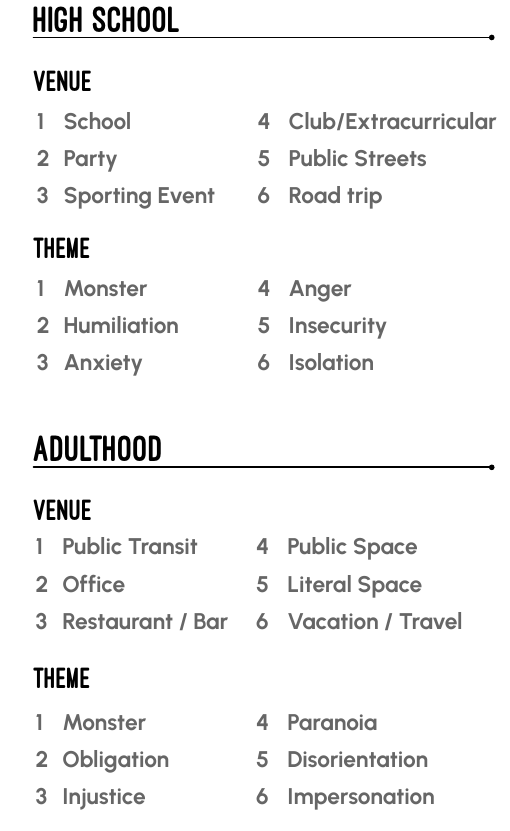
This table sets you up with a particular vibe. That vibe is geared to twisting the experiences we all have from day to day and turning it into a nightmare, to fit the horror theme of the game.
Contrast that with this table from Ferryfolk:
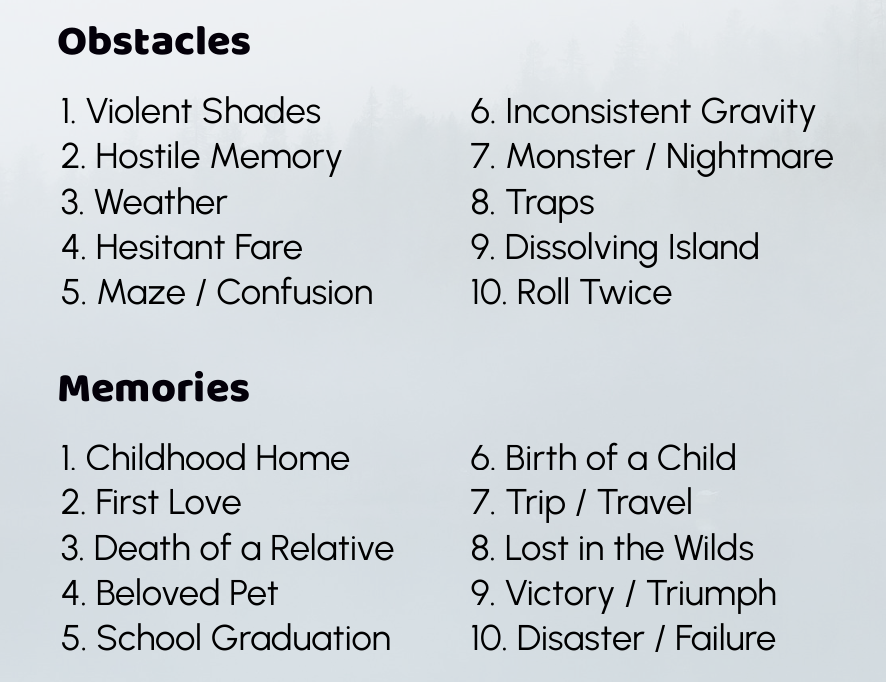
The theme of this table is more neutral than before, and it's not broken out by time period. Instead, it's more geared towards taking an idea and exploring the memory from a neutral lens, while the obstacle is more divested from the memory itself.
Two games with ostensibly the same core mechanic can have different vibes based on the choices presented in the table. A lot of 24xx games do this, too (as do a lot of other NSR games), which is something I've come to appreciate from a design aspect even if I'd prefer less random tables in my life.
Wrap Up
And that, dear readers is how I've almost accidentally made several games that are essentially "escape rooms without the puzzle". Hopefully some of this was useful to your own game design thinking. If you'd like to look at any of these games they're all available here: