
On Closed Ecosystems
A bunch of thoughts around closed ecosystems and the consequences of using them for TTRPG community.


This post is going to expand upon something I raised in my Remote RPG Tools post:
 Alex Ward
And that's the section near the bottom about Discord and how I'm very concerned about the consolidation of gaming history into walled gardens. I want to explore some things we can do to make those ecosystems less closed while also trying to meet communities where they already are. I'm not sure how well any of this is going to work, but I want to do something.
Other Reading
Before we begin, I really want to call out Molly White's blog - Citation Needed. She shares a similar sentiment in one of her most recent posts, and it's an exceptional read, if you'd like to take a small side quest.
 Molly White
Restating the Problem
If you read the Discord section of my prior post, I talk a lot about how Discord makes it basically impossible to back up or archive posts, especially those from their "Forums" product. I muse about how they might enshittify their service, and how we can see the beginnings of that as they seek profitability.
I also compare them to Google+, the prime historical example of RPG history lost to the ether (to varying degrees, more on that later).
Why is all of this a problem? If people want to chat in a place that cannot be archived, do we even care? I honestly don't know what the prevailing sentiment is, but I hope it's one where we care about the discussions we've had in the past as a wider TTRPG community and want to look to the past to make the future of the hobby better.
Of course, there are things in the historical record that are outright foul and probably should be binned, but that's also the nature of being human - history is filled with bad things. We shouldn't amplify them, nor should we forget them lest they happen again.
Baseline: The "Old" Web
In the days before we had monolithic platforms living off of our user generated content (UGC) in exchange for helping us connect to other people with similar interests, we essentially had a bunch of forums and blog rings spread across the internet.
To this date, blogging remains a relatively prevalent part of a lot of the hobby. There are a ton of great blogs out there, many of which I've linked to before, and the sharing of thoughts via those blogs is still relatively strong. You're reading this on a blog, after all.
There are still a few big forums kicking around, RPGNet being the first one that comes to mind.
In these cases, the software and the costs to keep the community running are handled by either a private individual or group of those individuals. That makes them susceptible to going offline if that individual decides to nuke them (I've had this happen to me) or if there's an emergency and there is no succession plan in place.
Taking Backups or Archiving the "old" web
Fortunately, backing up or archiving the "old" web was (and still is) a relatively straightforward affair. Scraping or submitting the public posts to the Internet Archive mostly worked (We'll talk about G+ in a bit). Bulletin Board admins can take database backups and make them available.
If you want to go find an old topic on any of the now defunct forums, you can look up the thread in the Internet Archive and it'll largely still render correctly. Not everything works, though. Images might be broken, links may be difficult to follow, but the text of the thing will largely be okay.
Unfortunately, forum software of the era also didn't really have much in the way of allowing a community member to download their own content for archival purposes. We've gotten better in the intervening years. Both Discourse and NodeBB allow you to export your data individually more easily, and migration plugins are more common.
Right, so how is that different from letting a social media company do the management?
Arguably, the start of communities consolidating on social media started right after the dotcom bubble, right at the turn of the century. This is where you see MySpace get into its stride, Xanga and other semi-blog-semi-social platforms start gathering users. Facebook would enter the scene later, as well as a bunch of platforms directed with connecting companies to their community.
There were several reasons why these companies took off, the main one being the idea of the "social graph", you can find people you know and spider out from there into content you care about in a more direct manner than joining hobby-centric forums. Another was the barrier to entry was super low for someone wanting to start a new community (and this is still true of Discord), you didn't need the technical skills to host a forum, you just had to click a few buttons and you'd have a group space all your own.
In exchange for this, you'd cede control over the actual mechanics of keeping the bits going over the internet to the faceless company hosting your stuff. Your admin isn't your pal Kevin, it's Facebook. Where Kevin's goal is community service, keeping a thing running because he likes it, Facebook's is to make a profit off of you and your content. If they fail to do so, well, turning it off is just doing business.
Now, on a large enough forum, the people keeping the servers running behind the scenes may be totally faceless to the average community member. That's about the same as the for-profit company who employs hoards of administrators to keep the data safe.
I think the key difference here is that the incentives are very different between the social media companies and community forums. The community forum wants nothing from me other than my (hopefully quality) thoughts. Maybe some donations to cover hosting costs.
Take one community I'm a member of, Gamers With Jobs. The people running the show are very visible and accessible via both the forums and other channels. They're not trying to make money off of the community. We've established a trust relationship. I personally know the people keeping the servers up.
 Felix Threepaper
Likewise, with a social media company, the people managing the community rarely have any control over how the data is preserved or managed. For the GWJ forums, I can be assured that the data is relatively safe. I can also be assured that their incentives to keep the site running aren't aligned with "how do we make money".
Unfortunately, Discord does not offer those kinds of controls. There's no easy backup / restore functionality on Discord (this is also true of Facebook, as far as I'm aware). GWJ suffered a bot attack against the Discord, which resulted in a lot of community members getting kicked, and a lot of chat history permanently deleted. We can't recover any of that. There's simply no way to do it.
So what happened to Google+?
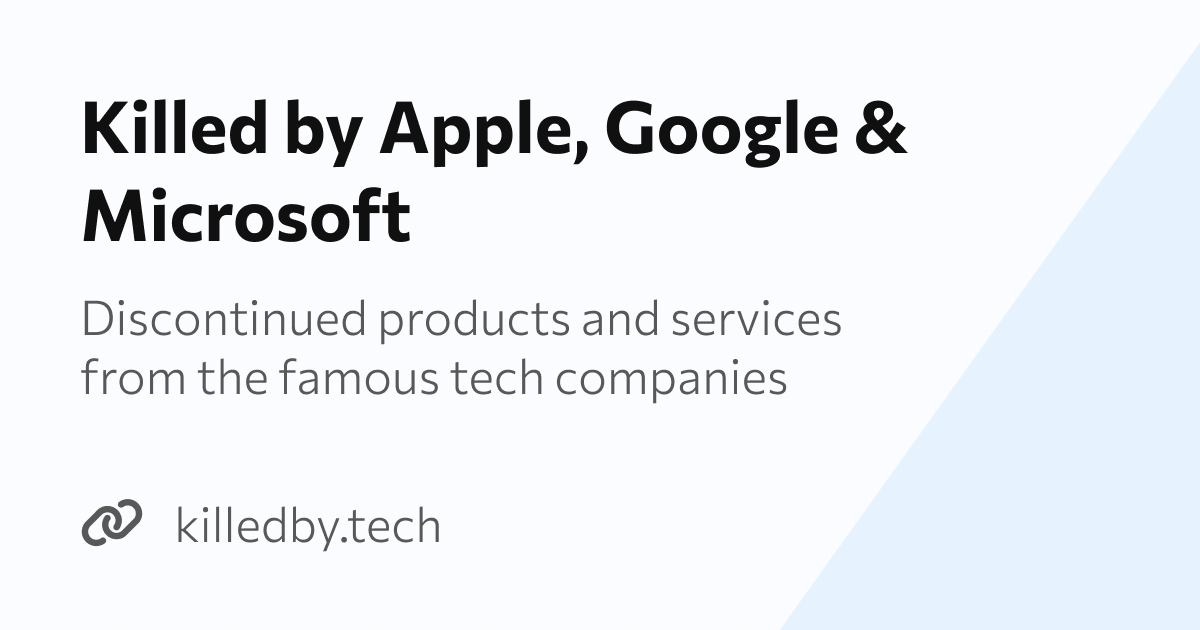
The shortest version of this story can be summarized as "Google likes to shut down things." Here's a nice list:

But, more seriously, I think Wikipedia's got the best summary for this:
 Contributors to Wikimedia projects
.svg/1200px-Google_Plus_logo_(2015-2019).svg.png)
There are essentially two parts to the major setbacks behind Google Plus shutting down.
- The features of Google Plus were very useful to the wider TTRPG community, and nothing else has come close.
- Archiving and backing up these communities was difficult.
I can't really speak to the first bullet. I wasn't active on Google+ and so I didn't experience the magic of it as a community builder, particularly for TTRPG folks.
But for the second bullet, I can definitely comment on. Unlike some other things of the era, you could in fact export data from Google+ via a series of APIs (and there were a few third-party things at the time that could get data out) and the personal data is included in Google Takeout. However, that was still a problem for exporting entire communities. Doable via the APIs, but as far as I'm aware, there was no straightforward "get your content out of Google+".
So, what we're left with now is the Wayback Machine. You can go poke around here:


Finding general stuff on the Wayback Machine for Google+ is ... basically impossible unless you already know what you're looking for. It's poorly indexed in search results (especially on Google, which is hilarious).
Certain communities were archived by others
A group of folks did manage to archive 30 TTRPG communities. I've been getting some DB errors, but when it loads it seems to be relatively complete.
 Jeremy Strandberg
What happened to those Google+ Communities?
Hilariously, a lot of them went to forums. Blades in the Dark, one of the larger communities on Google+ went to Discourse.

I have no idea how many active members made the switch from a Google+ community to a more specific forum. There is a barrier there (having multiple accounts, for one, if your new software doesn't support Google SSO).
But we march on.
Okay, so what makes Discord worse?
It's a perfect storm. Discord has:
- Low barrier to creating a community for both real-time chat and forums.
- Good voice chat and convenience features.
- No way to back up the community data.
- Is trying to figure out how to become profitable.
What I'm seeing is that some communities are extremely active on Discord and at least a subsection of the community's activity is localized around those Discord servers.
There are some interesting examples of this phenomenon as well. Paizo has a few different community-created Discords besides the official forums, and the discussions that happen in each space are often very different.
So, we're getting a lot of quality information generated in Discord, which is very difficult to get out of Discord. Meanwhile, Discord is trying to become profitable and wants to IPO. We've got another potential Google+ situation brewing here. It's a great tool for having discussions that has an even tighter control over the content you've created, which has to figure out how to make money now.
It's liable to degrade service, and there's a non-zero chance that they'll make some bad decisions and have to shutter. I don't think that's likely, but it is a possibility.
What do we do instead?
I don't have a great authoritative answer to this one. I can tell you what I've been looking into, but there are trade-offs in every direction.
I've been digging more into the Fediverse mixed with IndieWeb stuff lately and thinking more about how those technologies can play into "the convenience of a managed service" combined with the resilience of a federated / distributed network.
One of the interesting contrivances of the Fediverse is that "you can just move from one server to another as you desire" or "you can follow things from anywhere" - which is also something that IndieWeb also digs into a bit with IndieAuth and Webmentions. There's still a pretty high barrier to technical entry if you want to run one of these things yourself, but there are several companies doing stuff like masto.host providing reasonable Fediverse hosting - with the ability to migrate / take backups should your host implode. Since everyone's also kinda interacting with where they want to be, it's a bit "safer" than trusting your digital life to a big company.
The UX of all of that is complex, though. Following across servers is a pain. Funding is an issue.
I dunno what the actual answer is (if there is one), but if I figure something out, I'll let y'all know.